
You have been through integration before. You know what a real short circuit looks like: the channel trips, the team investigates, the fault is located, and the issue is fixed.
But sometimes the channel keeps tripping, and there is no fault to find. The wiring checks out. The load is within spec. The system appears healthy, yet the trip repeats. Under schedule pressure, the next instinct is often to reach for a firmware adjustment or a software workaround just to keep the program moving.
That is where many integration teams lose time. False channel-tripping is one of the most frustrating and frequently misdiagnosed issues in the integration of military electronic circuit breaker units (ECBUs). In many cases, the root cause is not the wiring, the load, or the software. It is the channel circuit design inside the PDU.
What Is False Channel-Tripping?
An electronic circuit breaker has two essential jobs: to protect downstream equipment and platform wiring during fault conditions, and to remain on during normal operating conditions. False-tripping occurs when the second job fails and disconnects power, even though the system is operating within the expected envelope.
In military platforms - airborne, ground vehicle, naval, or mobile command systems - false-tripping has real consequences. During integration, it delays testing and creates unnecessary troubleshooting loops. During operation, it can interrupt a subsystem that should have remained powered.
The challenge is that a false trip can look exactly like a real one. The channel opens, voltage collapses, and the system reports an overcurrent event. Without the right diagnostic path, engineers can spend valuable time chasing faults that do not exist.
The Root Cause: Two Protection Behaviors That Must Stay Separate
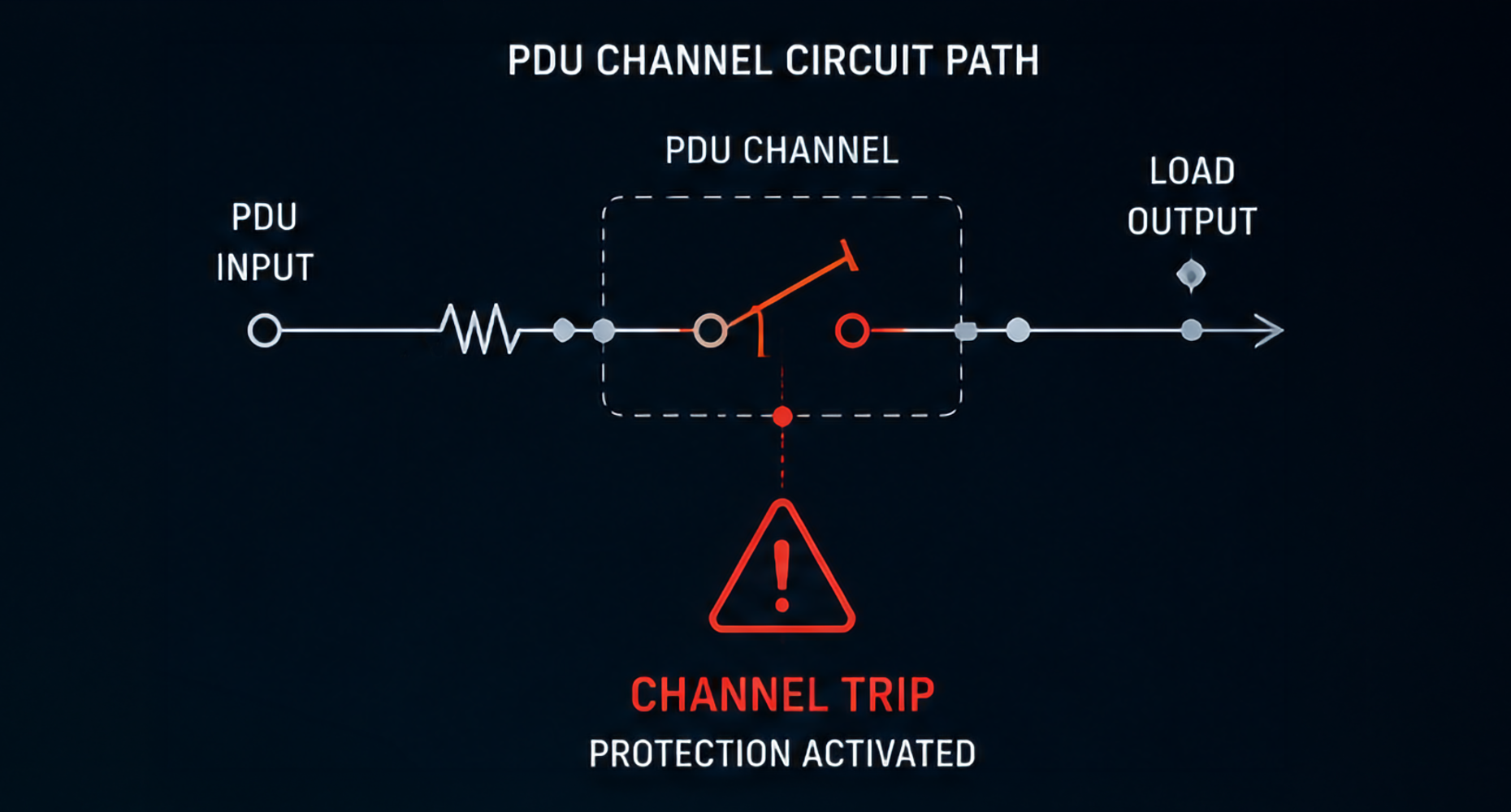
A well-designed solid-state PDU channel typically includes two different current protection behaviors:
- Overload protection (I²T): A time-integrated protection function that models thermal stress on wiring. It allows short current peaks, such as startup inrush, because the wire can tolerate brief overcurrent without damage.
- Short-circuit protection: An instantaneous protection intended to protect the source voltage from falling and the electronics along the way from damage.
These two behaviors serve different purposes and must operate independently. When a channel circuit design allows short-circuit protection behavior to interfere with normal operating conditions, a healthy inrush current can be interpreted as a fault. The result is an unnecessary channel trip.
This is not simply a tuning issue. It is not a software configuration problem. It is a channel design issue. The reliable fix is a PDU channel architecture that correctly separates these protection functions from the beginning.
Why Software Patches Do Not Solve the Problem
When false-tripping appears during integration, software adjustments can look attractive. Teams may raise overload thresholds, change timing delays, or modify current-limit settings. Sometimes these changes suppress the symptom long enough to pass a specific test.
But they do not solve the underlying problem, and they can introduce new risks:
- Raising overload thresholds may reduce the wire protection the PDU is supposed to provide.
- Changing current trip limit behavior can make it harder to respond correctly to a real fault.
- Firmware-based workarounds must be revalidated after updates and configuration changes.
- A workaround that works on one platform variant may not transfer cleanly to another.
- Undocumented threshold changes can become a long-term maintenance and liability issue.
The engineering team that maintains the system months or years later may inherit software adjustments that exist only to compensate for a hardware limitation. That is a fragile foundation for any mission-critical platform.
The Bottom Line
False channel-tripping is rarely solved by wiring checks or software workarounds alone. In many cases, it points to the PDU channel's hardware design - and requires a hardware-level solution.
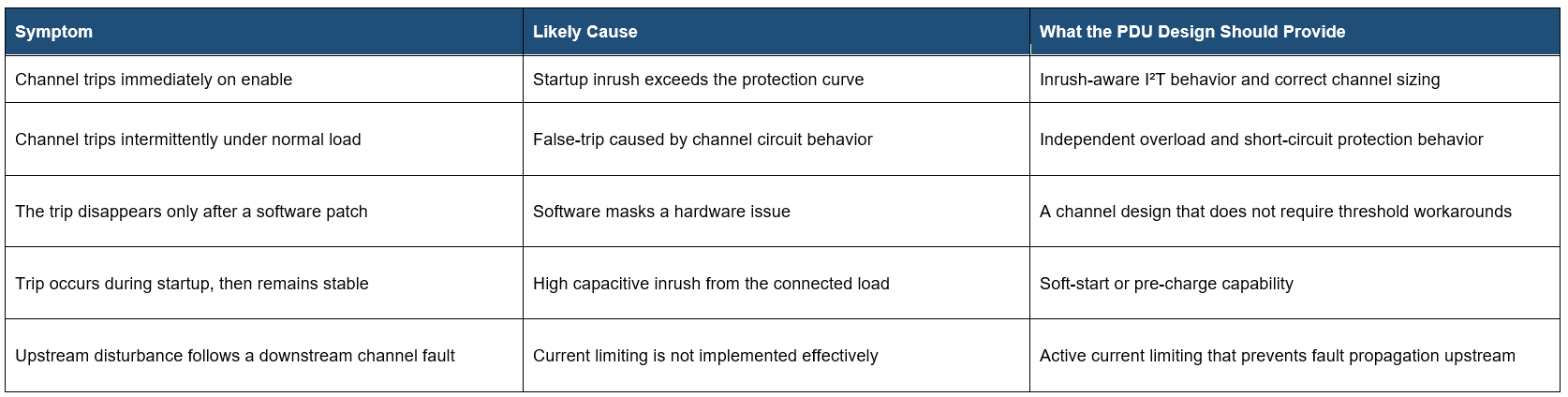
Diagnosing the Trip: A Quick Reference
Not every trip is a false trip. The table below helps separate common symptoms from likely causes and the design features that should address them.
What to Look for in a PDU Channel Design
If you are evaluating PDUs for a new program or reconsidering an existing solution that is creating integration issues, focus on the channel architecture - not only on the datasheet's current rating.
- Independent overload and short-circuit behavior: The two protection functions should operate through separate logic paths and should not interfere with each other under normal load conditions.
- Active current limiting during short-circuit events: A downstream fault should be limited before it propagates upstream into the platform bus.
- I²T protection per channel: Wire protection should be appropriate for the channel, wire gauge, and application - not based on a generic threshold.
- No software patching required: Stable operation should not depend on firmware changes that compensate for hardware behavior.
MIL-STD Compliance Adds Another Layer of Complexity
False-tripping can also be triggered by platform-level power behavior. Airborne systems designed to MIL-STD-704 must tolerate a defined power-input environment on 28 VDC buses, including transient conditions. Ground vehicle applications under MIL-STD-1275 can face even harsher input events, including load-dump conditions.
A PDU channel that was not designed to tolerate the relevant input range may trip during normal platform transients - not because the downstream load failed, but because the PDU itself is reacting to a voltage event it was not built to absorb.
This type of nuisance trip is often missed during benchtop testing, where lab power supplies do not always reproduce military-grade transient profiles. It may appear only during platform-level integration, qualification, or field operation.
Design Requirement to Verify
Confirm that the PDU-rated input range covers the relevant MIL-STD-704 or MIL-STD-1275 operating and transient environment before integration. A narrow input window can become a hidden source of nuisance trips.
The Milpower Source Approach
Milpower Source standalone 8- and 16-channel, 28 VDC, Ethernet-controlled ECBUs are designed for military airborne and vehicle applications, with channel architecture built to prevent false-tripping rather than compensate for it after integration.
The channel design separates overload and short-circuit behavior at the circuit level. Stable operation does not require software patching under normal conditions. When a real fault occurs, active current limiting helps stop short-circuit propagation upstream, protecting the bus as well as the individual channel.
For programs that require MIL-STD-704 compliance, the input range is designed to support the relevant normal transient envelope. MIL-STD-1275 options are available for vehicle applications. Each channel provides I²T overcurrent protection, supporting wiring up to 10 AWG (30A).
The goal is straightforward: a PDU should remain on when there is no fault and respond correctly when there is one.
Conclusion
False channel-tripping is solvable, but only when it is solved in the right place. Software adjustments, threshold tuning, and firmware workarounds may help a program move past a test point, but they are often signs that the hardware behavior is not where it needs to be.
For mission-critical platforms, the preferred approach is a PDU channel design that properly separates protection functions, tolerates the relevant MIL-STD input environment, and delivers stable operation without software compensation.